Mary Cooper was a working class Victorian who gave birth to 8 children, outlived 2 husbands and lived through 2 world wars. Mary was born in Wakefield, West Riding of Yorkshire 20 July 1893 to Thomas and Elizabeth Ann Cooper both of Darlaston, Staffordshire. Her father, brothers and husbands were coal miners (sometimes soldiers); her sisters cotton spinners and mill hands. Mary herself became a Rover in a Wakefield cotton mill.
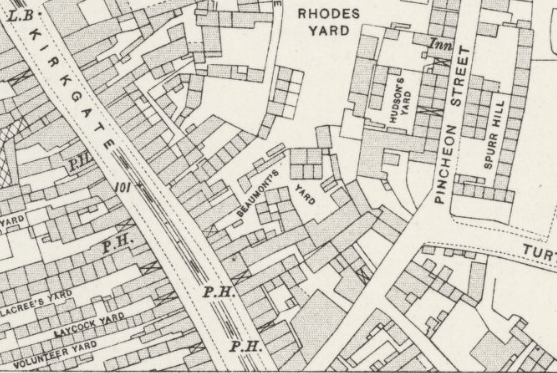
Mary’s parents,Thomas and Elizabeth, appear to have settled in Wakefield after a fairly peripatetic journey through the Nottingham and Northumberland coalfields; Mary’s older sister, Eliza was born in Bulwell, Notts. and Edith was born in Seghill, Northumberland. The 1891 Census shows the Coopers living at 7 Pincheon Street, Wakefield and then 9 Beaumont’s Yard – both off Kirkgate.
Home Birth
Elizabeth would most likely have given birth to Mary at home in either 7 Pincheon Street or the adjacent Beaumont’s Yard. Both were pretty busy and unsanitary places. The 1891 census lists 8 people coming and going including Thomas’ father Joseph, now a widower aged 65 but still working as a coal miner. Elizabeth his wife, children Kate, Eliza, John, and three lodgers: Samuel Cooper, William Jones and William Hickman. Mary was not baptised until aged 5 on 18th September 1898 at All Saints Cathedral. The address given is simply Kirkgate, which suggest they had moved by this date to 9 Beaumont’s Yard, by the time of the 1901 Census. By the tun of the century Joseph appears to have passed; Elizabeth (44) has also given birth to two surviving children, Mary (7) and Emma (3). Eliza (19) and Edith (17) were still living in the family home but are now employed as Cotton Spinners. John is now 12 and joined by Thomas (10), Mary (7) and Emma (3).
Wakefield Yards
Wakefield had scores of yards like Beaumont’s Yard. They were never designed to house people and its no wonder they were the subject of concern and inquiry throughout the latter half of the 19th C. Essentially the yards were medieval burgage plots – “crofts and tofts” running off the main thorougher fares of Westgate, Northgate and Kirkgate. Many of the yards were behind Wakefield’s numerous inns. As Wakefield’s medieval economy developed the dwellings fronting the street were rebuilt with entrances to the croft’s through a passage. In towns tenants stopped growing crops on the crofts and used the land for cottage industries – malting, baking, brewing, tanning, soap making, stabling. In the 1700s as the industrial revolution gathered pace people migrated from agricultural labour in the countryside to factory work in the towns. The yards were quickly built on to provide basic housing. They were often unpaved bare earthed with no drainage; people relied on wells and cisterns for water until mid century installation of piped water. Most were dead ends. Human, animal and industry waste was dumped in pits or middens which were infrequently emptied by night soil men. Not surprisingly Wakefield suffered from outbreaks of highly contagious diseases such as cholera.
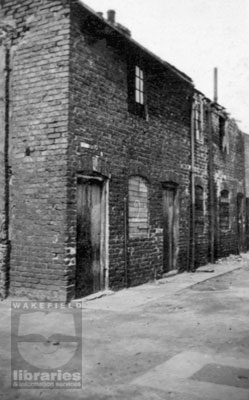
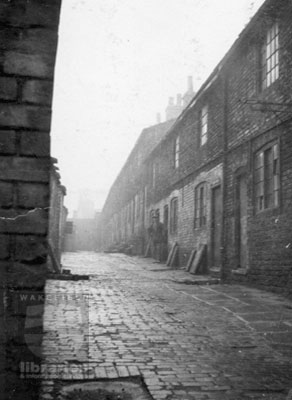
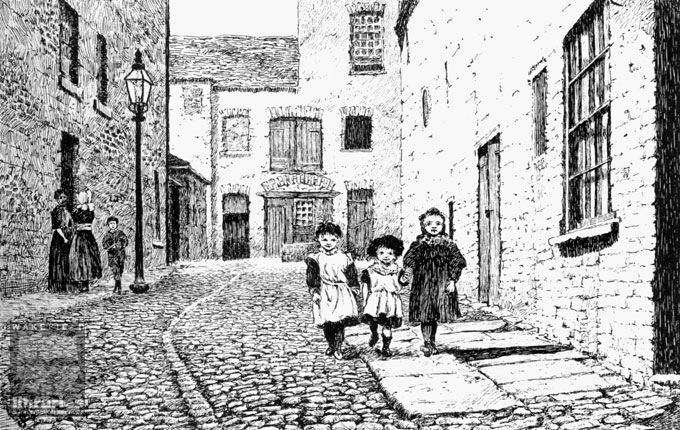
The Borough Council began take action from the 1850s but houses in Beaumont Yard were still in use and still being condemned in 1905 as “unsatisfactory” by the Borough’s Medical Officer of Health, Mr Gibson. Whether this forced the Coopers to move south of the River Calder we don’t know but by 1911 they were living at Quaker Houses, Belle Vue, Doncaster Road.
The 1911 Census was completed by Mary’s brother John, now 23, described as a “Shop Assistant (General Dealer)”, “working from home”. It is difficult to know whether John completed and signed the form because his father, Thomas was at work or, was illiterate. It is interesting that John had not followed his father into coal mining and is either running a small shop in the family home or the family live above a shop where John is employed as shop assistant. If Thomas was still working as a miner he would have a fair trek to the nearest mine at Park Hill. Elizabeth is 54 and had given birth aged 41 to her last surviving child, Emma; John reported in the Census return that she had given birth to 15 children, 8 of whom survived but 7 children died.
Marriage, Children and War

At sometime in her late teens, Mary met George William Fynn – a Barnsley lad and coal miner. They married on 2nd August 1913 at St Andrew’s, their nearest church on Peterson Road. No wedding picture survives if one was taken but it is to be hoped it was a gathering of friends and family and a happy day in Mary and George’s life. On 27th May the following year, 1914, Irene (my maternal Grandmother) was born, probably at home, which at the time of Mary’s marriage Mary was “2 Brick Yard, Green Hill”; this is almost certainly Brickmaker Yard on the 1890 OS Town Plan. George lived at 2 Rutonville Place, Stanley Road.
War
Two months after Irene’s birth their world, like that of so many others, was shaken by the events unfolding in far of Serbia and the consequent declaration of war by Great Britain on 4th August 1914. The following month on 3rd September George volunteered to serve his King and country. A year later on 28th September 1915 he was killed in action during the first engagement of his unit at the battle of Loos en Goehelle – a coal mining town in northern France. Mary would have received the dreaded news in a letter from the War Office not long after his death. A week later the Leeds Mercury carried the announcement with some rare biographical details.
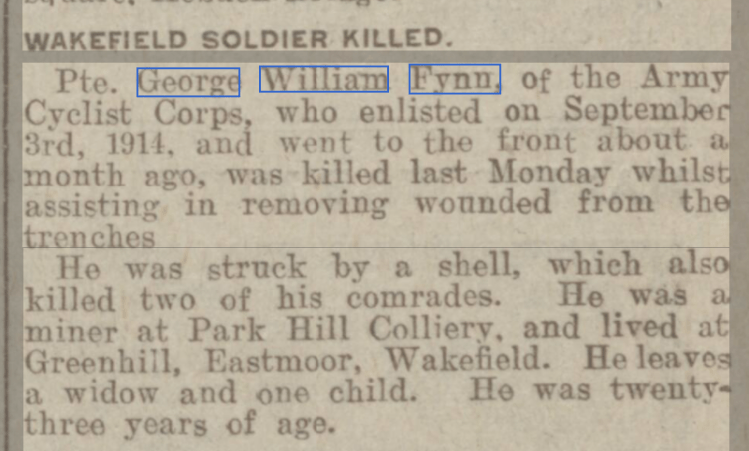
How Mary coped once George joined up and after his death we do not know, it would not have been easy, she did not begin receiving her widows pension until 1st May 1916. It is possible she began work again. June Thorp, Irene’s daughter, was told that Irene stayed with George’s family in Barnsley but this proved less that satisfactory to Mary and she was returned to her care in Wakefield or Ossett.
The bad news for the Coopers didn’t end with Georges death, Mary’s sisters also married and lost their husbands and loves during the war. Older sister Edith’s husband, John Bartle Plant was killed 12th September 1917; a year later Emma’s husband, John William Woodcock was killed 18th September 1918. Both remarried and started second families, Emma to Harry G. Kilburn in 1921, and Edith to William Winterburn in 1919.
In 1917, two years after George’s death Mary married Edward Hinchliffe, a bachelor and miner, from Ossett. Mary now lived at 7 Teall’s Yard off Dale Street; Edward lived in South Terrace, south Ossett. Mary’s thoughts and feelings are lost now but the surviving family photos of Mary with her children and grandchildren suggest a life with much happiness was found.
 Genealogical Jigsaw