
“FATAL ACCIDENT AT BOWLING – At a quarter to five o’clock yesterday morning an accident occurred in the shed of the Great Northern Railways Company, in Essex Street, Bowling, which resulted in the death of a fireman name Wm. Thorp, aged twenty five who resided at 90, Prospect Street, and was employed by the company. It appears that Thorp was engaged in oiling his engine, which was unfortunately set in motion by an engine driver named Foulds. Thorp called out but before he could be extricated he was killed. The body was removed to his residence, and an inquest was opnened by Mr Hutchinson, The Borough Coroner, at the Town Hall yesterday, but was adjourned until Wednesday.”
Bradford Observer 10th May 1881, page 8
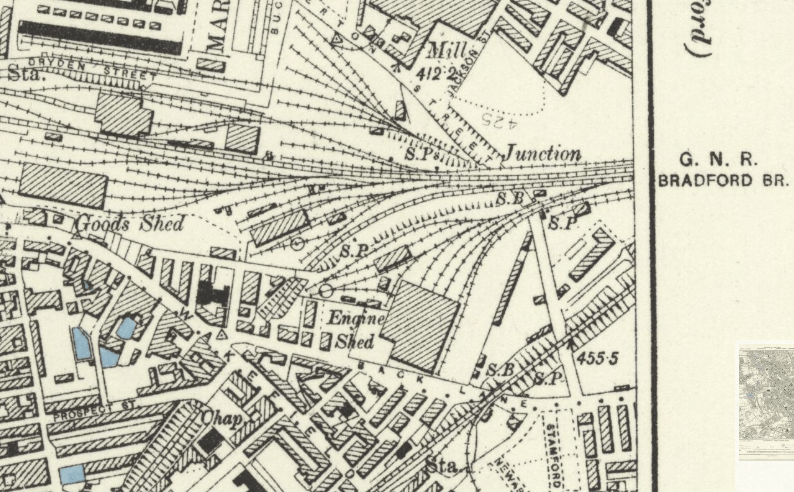
And thus an all too common industrial accident in Victorian England ended the short life of William Thorp. He left a grieving Widow, Sarah (nee Dawson) but it would seem, at the time of writing no children. The inquest was held on 13th May 1881 at which the jury returned a verdict of “Accidental Death”. The funeral was held on the same day as the inquest in the unconsecrated section of Undercliffe Cemetery. And thereby hangs a tale.
Undercliffe Cemetery
Undercliffe Cemetery was opened and was consecrated with great ceremony in 1854 by the Bradford Cemetery Company as a local solution to the rapidly growing population and the rapidly growing number of deaths, especially after the cholera epidemic of 1849 took 426 Bradford folk and overwhelmed the capacity of St Peter’s, Bradford’s parish church. An area in the eastern part of the cemetery was left “unconsecrated”, that is, set aside for non-conformist burials and presumably those who were not baptised.
William’s headstone according to Jim Thorp’s notes reads “Husband of Sarah Thorp and beloved son of M. J. Thorp”. Whether Mary Jane attended the funeral on the day or not we do not know; at the time Mary Jane was living near Bath, Somerset (1871, 1881 census), where she worked as the house-keeper for Rev William Williamson. We know from William’s birth certificate that his mother was Mary Jane Thorp (Mary Thorp on the certificate), and we also know that his father is not recorded, clearly indicating that William was born out of wedlock. He was born on 12 September 1855 at Windhill Crag, Shipley a few miles north of Bradford. Mary Jane is unable to sign the certificate but makes her mark.
Windhill Crag

In 1851 Mary Jane was still living at North Lane, performing the domestic duties for her father, Henry and five siblings, William Henry, John Roebuck, Elizabeth, Martha and Robert. In 1856 her brother William Henry married Mary Ann Carter at and gave his place of residence as Windhill. Given that Mary Janes son was born in Windhill it seems likely that she had moved out of North Lane and was lodging with her brother. Windhill Crag is now part of this author’s cycle commute to Peel Park, Bradford, or rather it was until lockdown in March 2020 when the “first wave” of the coronavirus pandemic led to “home working”. Cycle route (NCNR 66) follows the course of the now defunct Bradford Canal and also the ghosts of my ancestors!
How long Mary Jane and William stayed in Windhill is unknown, after her brothers marriage living conditions may have become too crowded and awkward. Five years later in 1861 Mary Jane is back in Headingley, now living, without William, as a “servant” at Otley Road Parsonage, Headingley in the household of Rev William Williamson. A five year old William Thorp, scholar, appears in the 1861 census living with the Hutchinson family on Clap Lane, Horsforth on the opposite side of the Aire Valley. Why William is with this specific family is unknown, however, his Auntie Ellen, Mary Jane’s sister, was living at the Parsonage, Horsforth from 1855 (Ann Senior Bible dedication). It may well have been that the Hutchinsons were friends of the family or the Vicar, and in a position to help raise young William.
Wooldale
At some point William moves to Wooldale, Holmfirth where he appears in the 1871 Census, aged 15, living with his Great Auntie on his mother’s side, Sarah Thewlis (nee Senior). Sarah (64) is shown as a widow and head of the household. William describes his occupation as apprentice plumber. It very much looks like a Victorian family support network has kicked in and a future for William has been found support through the Thorp – Senior family connections. His teacher or master was almost certainly Sarah’s son, James Shaw Thewlis, who is shown living next door at Lane End where he is described as Plumber and Glazier. If he served the traditional 7 years he would most likely have started around age 10 (1865/6) and completed his training when he reached his maturity age 21 (1876/77).

Return to Bradford
Whether William completed his apprenticeship and found any work as a plumber we don’t know, by 1879 he had returned to Bradford, to marry Sarah Dawson on 25th October, aged 24. Sarah is already a widow, and at age 38 is some 14 years William’s senior. The fact of his employment as stoker at the time of his death in 1881 suggests that plumbing didn’t work out. At the time of writing it would appear William and Sarah did not have children and this branch of the family effectively ended with the death of William. To date no further trace of Sarah has been found.
 Genealogical Jigsaw