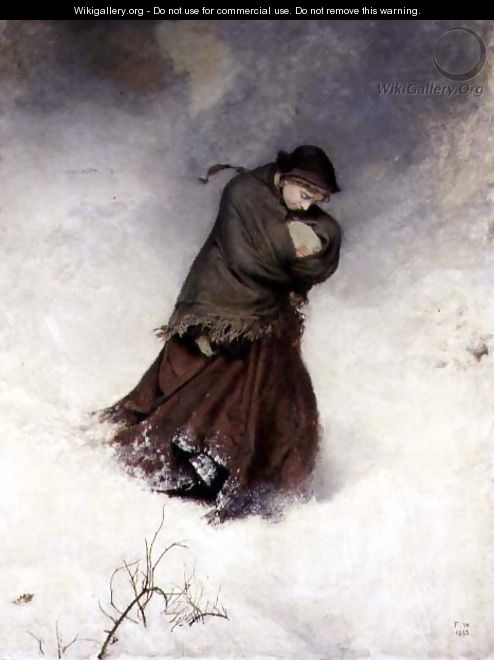
At the age of 24 in 1855 Mary Jane gave birth out of wedlock to William, and became a single mother in Victorian England. Author’s at the time such as Elizabeth Gaskell in her novels Mary Barton (1848), and Ruth (1853), described the precarious, fragile, frightening and unfair situation in to which, so called “fallen women” found themselves (Raines, 2016). However, Mary Jane’s future and that of her son suggest that families were fully aware of the dangers and could, indeed, would also use their resources to create different outcomes.
It is doubtful that Mary Jane or her family had read or were familiar with Gaskell’s novels and the re-evaluation of single mothers that these and similar works would ignite. For one thing Mary Jane probably didn’t read and write. We know from William’s birth certificate that she could not write and left a simple mark. Mary Jane’s family probably didn’t have a great deal of leisure time for reading either. Her father was single parent following the death of his second wife in 1850 and was undoubtedly kept fully employed putting bread on the table. Mary Jane as the eldest woman in the household effectively became mistress of the house with five younger siblings to feed, wash and clothe.
It didn’t begin this way but the margin between safety and destitution was always narrow and remained so until social welfare provision began to replace the poor laws in the 20th century. Mary was born in Hull, her father’s home town in 1830, the forth sibling following Sarah Ann, Ellen and Marshall. Henry had a trade, he’d completed his apprenticeship as a plumber, and as a journeyman he took up the trade on his own account. Mary Jane’s mother, Ann Senior, was from a well established Wooldale (Holmfirth) family. What drew Henry to the Holme Valley we do not know; it is possible he was re-connecting with family – there is or was an abundance of Thorps in the Huddersfield area. Meeting and marrying Ann is certainly the cause of his remaining there until he return to Hull with his new family where Marshall was born on 9th April 1827.
Childhood
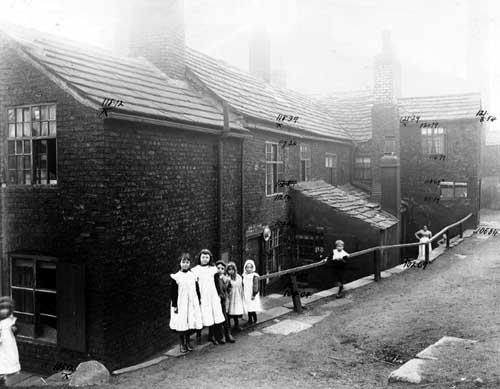
The known facts are fairly straight forward. Mary Jane was born in Hull in 1830 and before the family moved to Bank, Leeds by 1834. By 1841 the family were able to move to the leafier, upwardly mobile village of Headingley. The picture of Bank, below, was taken some 70 years later as part of “slum clearance” work; it gives an impression of what life may have been like in an inner city industrial area with foundries, mills and factories hugger-mugger with unsanitary housing – no inside running water or bathrooms. All powered by coal burnt in boilers and open domestic hearths. Leeds, like many northern towns experienced major cholera outbreaks in 1832 and 1849 but there were many other threats to the health and survival of infants and children. Despite this, as the later picture shows many families were not without a deep pride in their appearance: as the white pinafores on these young girls shows: cleanliness was next to godliness, even if it did require long and arduous domestic work by the women of the household.
When Mary Jane’s childhood ended is more problematic. Societal views about what it meant to be a child were undergoing profound changes at this time. Childhood was beginning to be thought of as a special period of innocence and purity. This emerging idealised view brought in to question the employment and working conditions of children in rapidly growing industries, particularly woollen and cotton mills. Factory work was now seen and understood to be detrimental to the moral and physical health and wellbeing of children. One practical manifestation of this was a series of Factory Acts that sought to improve working conditions, not least by setting a minimum working age of 9! These changes were long coming and had already impacted Henry Thorp, Mary Jane’s father. He witnessed, aged 13 the effective end of indentured apprenticeships in 1814 – a practice that stretched back to the middle ages. However, for working class children, like Mary Jane, in late Georgian and early Victorian England their early years were still about keeping from under foot and learning to become useful adults, that is, able to contribute labour in the household or become wage earners outside. Although, some schooling may have been required in the workplace, for those put to work, it was not until Bradford MP, William Forster’s 1870 Education Act that education became compulsory for 9 to 12 year olds. We know from later documents that Mary Jane was unable to sign her name and likely received scant if any formal education.
Mary Jane’s life appears to have been confined to domestic labour in her fathers household until her mid 20s. Her childhood years were no doubt spent helping her mother and two older sisters with the myriad household tasks, fetching and carrying, washing, cleaning, preparing food etc. As her older sisters grew up they left to work as domestic servants in other households and so Mary Jane would gradually transition from child to adult as she picked up more duties and skills. Those responsibilities almost certainly increased when she was 15 on the death of her mother from heart disease in 1845. Although, Henry re-married the following year Mary Jane appears tied to the house and is bound even further with the death of her stepmother in 1850.
With Child
Somewhere around Christmas 1854 the 24 year old Mary Jane became pregnant. Who the father was and when she told her family we don’t know. The news must have gone down like the proverbial lead balloon as her son’s birthplace is given as Shipley (Yorkshire), 12th September 1855. It is likely she followed her brother William Henry to Shipley and stayed with him or close by; William was married in 1856 at Windhill Crag, Shipley.
Adoption
How long Mary Jane and the infant William stayed in Windhill is unknown, after her brothers marriage in 1856 things may have become too crowded and awkward. There is no record of the “illegitimate” William having been christened. Mary Jane and William may have moved back to her father’s house at 36 North Lane for awhile or she may have been forced by circumstances to give William up for adoption as a babe in arms or infant in order to find a job. This appears to be the case as the 1861 census, five years later, shows Henry, her father, now lodging at 38 Grove Street, Leeds. Mary Jane is back in Headingley, but living as a “servant” at Otley Road Parsonage, Headingley in the household of Rev William Williamson. A five year old William Thorp, scholar, appears in the 1861 census living with the Hutchinson family on Clap Lane, Horsforth. Why William is with this specific family is unknown, however, his Auntie Ellen, Mary Jane’s sister, was living at the Parsonage, Horsforth from 1855 (Ann Senior’s Bible dedication). It may well have been that the Hutchinsons were friends of the family, or the Vicar, and in a position to help raise young William.
Later Life
William’s life ended tragically in 1881 when Mary Jane was 50. At the time of William’s death she still lived and worked as a cook in the household of the Rev Williamson, now 81, but now resident at Fairstowe, Lyncombe & Widcombe, near Bath, Somerset. It’s not known whether she attended William’s funeral but she is acknowledged on his head stone. The following year on 11 May 1882 the Rev Williamson died, leaving an estate valued at £4,788 to his wife Jane Williamson. Jane died two years later in 1884. Mary Jane does not appear in the census records again until 1901 now “living on own means” in a cottage at Combe Monckton a few miles south of Widcombe. That she was able to live on her own means suggests that she had either been very frugal and managed to save or some provision had been made in the wills of her life-time employers William and Jane.
Refs
Raines II, Steven T (2016) The Evolution of Single Motherhood in Victorian England: Tracking Novels and Social Reception from 1853-1894. University of Iowa.
 Genealogical Jigsaw